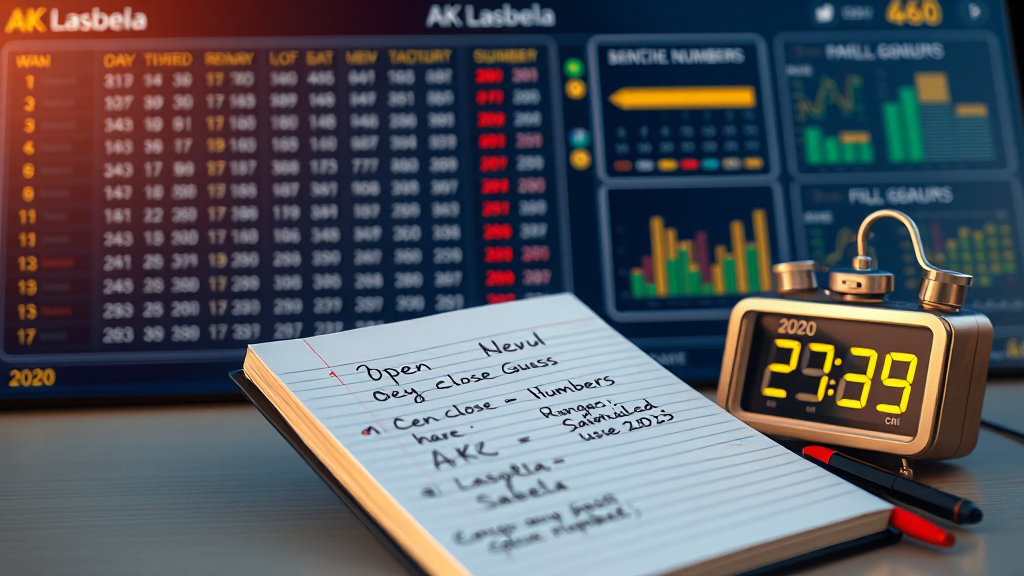
AK Lasbela: A Complete Guide to Daily Results, Records and Guess Reports
For anyone who follows the daily lottery and guessing scene in Karachi, the name AK Lasbela is instantly recognizable. It sits at the center of a family of games that includes Ghas Mandi, Lasbela 1, Lasbela 2, Lasbela 3 and the AKC series, and it has become one of the most searched terms among people who track open close guesses, VIP double numbers and single guess tips. This guide explains what the platform actually offers, how the different game codes fit together, and why a reliable results portal matters more than ever for anyone who follows these numbers closely.
What AK Lasbela Actually Is
AK Lasbela is best understood as an online results and guessing portal rather than a single game. It collects and publishes the outcomes of several related lottery-style games under one roof, then adds analytical tools on top of that data. Instead of jumping between scattered pages, users can open one destination and see the full picture: today’s numbers, yesterday’s outcomes, historical records going back several years, and a set of prediction-style features that many followers find useful for planning their own guesses.
The brand covers a specific set of game codes that regular users will recognize immediately. Ghas Mandi, often shortened to GM, is one of the core games. Then there is Lasbela 1 (LS1), Lasbela 2 (LS2) and Lasbela 3 (LS3), each with its own schedule and result pattern. The AK and AKC codes round out the lineup, giving the platform a broad daily coverage that keeps visitors coming back throughout the day. Because all of these are tracked in one place, the AK Lasbela Game ecosystem feels less like a collection of separate pages and more like a single, organized dashboard.
Why Daily Results Tracking Matters
The single most important feature of any results portal is accuracy and speed. When results are published late, or when numbers are copied incorrectly, the entire purpose of the site collapses. That is why serious followers look for a platform that treats the AK Lasbela Daily Result as a core product rather than an afterthought. A well-maintained result board should show the date, the game code, the open number, the close number and the final outcome in a clean, readable format.
Daily tracking is not just about today. It is about building a habit of checking in at consistent times so that patterns become visible over weeks and months. When you look at a single day in isolation, the numbers appear random. When you look at a month of entries side by side, you start to notice which numbers repeat, which combinations appear more often, and how the open close relationship behaves across different games. This is exactly the kind of context that a structured result page provides, and it is the reason so many users prefer a dedicated portal over informal updates shared in chat groups.
There is also a practical benefit: a proper daily result page reduces confusion. If two people are discussing the same game but looking at different sources, they can easily end up with different numbers. A single authoritative page for the AK Lasbela Result removes that ambiguity and gives everyone a common reference point.
Understanding the Game Codes: GM, LS1, LS2, LS3, AK and AKC
Newcomers often find the abbreviations confusing at first, so it helps to break them down. Each code refers to a specific game within the broader AK Lasbela family, and each has its own result page and history.
Ghas Mandi (GM) is one of the longest-running entries in the lineup. Followers of this game tend to check the AK Lasbela GM Result early because the outcome often sets the tone for how the rest of the day is discussed in community forums and message groups.
Lasbela 1 (LS1) is the first of the three numbered Lasbela games. It has its own timing and its own pool of frequently appearing numbers. The AK Lasbela LS1 Result is typically one of the most viewed pages on the site because LS1 is a favorite among regular players.
Lasbela 2 (LS2) follows a similar structure but with a different schedule, which means its result pattern does not simply mirror LS1. Anyone who tracks both will notice that the AK Lasbela LS2 Result sometimes diverges sharply from its sibling game, which is part of what makes comparison interesting.
Lasbela 3 (LS3) completes the numbered trio. Because it sits later in the sequence, the AK Lasbela LS3 Result is often used as a closing reference point for the day’s activity across all the games.
AK and AKC are the remaining two codes in the set. The AK Lasbela AK Result and the AK Lasbela AKC Result are both tracked with the same level of detail as the others, and together they complete the full daily picture. When people refer casually to AK Lasbela Satta, they are usually talking about this entire collection of games viewed as a single daily routine.
The Guessing Tools: Open Close, VIP Doubles and Single Guess
Beyond raw results, the platform offers a set of guessing and prediction features that many users rely on. These are not guarantees, and any honest discussion of them should make that clear. What they provide is a structured way to think about the numbers rather than a promise of outcomes.
The open close guess format is probably the most familiar. Users examine recent results and try to estimate which numbers are likely to appear at the open and at the close of a given game. The center formula is a related approach that focuses on the middle range of the number set, using historical frequency as its guide.
VIP double numbers are another popular category. These are pairs of digits that the platform highlights based on patterns observed in past results. Because doubles appear less frequently than mixed combinations, spotting them requires patience and a good record-keeping system. The single guess format narrows everything down to one number per game, which appeals to users who prefer a simple, focused approach rather than a long list of options.
All of these tools depend heavily on one thing: a deep, well-organized archive of past results. Without that foundation, predictions are just guesses with no grounding. This is where the historical record becomes essential, and it is one of the strongest reasons to use a portal that maintains its data properly.
Historical Records from 2020 to 2026
One of the most valuable assets any results site can offer is a long, searchable archive. Short-term tracking tells you what happened this week. Long-term tracking tells you what has happened over years, and that is a very different kind of information. The AK Lasbela Record spans multiple years, giving users the ability to look back at how specific games behaved across different seasons and periods.
A long record is useful for several reasons. First, it lets users verify claims. If someone says a particular number has been “due” for a long time, the archive can confirm or contradict that. Second, it supports pattern analysis at a scale that short-term tracking cannot match. Third, it provides context during unusual periods, when results deviate from what regular followers expect. A record that stretches from 2020 through 2026 is essentially a reference library, and treating it that way changes how you use the site.
Reports are another part of this archive function. Rather than scrolling through individual daily entries, users can pull up summarized reports that condense weeks or months of data into a more digestible format. Winning papers, which document notable outcomes, are also part of the offering. Together, these features turn a simple result page into something closer to a research tool.
How to Use the Portal Effectively
Getting the most out of a results and guessing portal comes down to routine. The users who benefit most are the ones who check in consistently rather than sporadically. A practical approach looks something like this:
Start by confirming the daily results for each game as they are published. Check GM first, then move through LS1, LS2 and LS3, and finish with the AK and AKC codes. Make a note of anything unusual, such as a repeated digit or an unexpected close number.
Next, review the guess features with a clear head. Look at the open close suggestions and the VIP double numbers, but treat them as inputs to your own thinking rather than as instructions. Cross-reference them against the historical record to see whether the suggested patterns have any support in past data.
Finally, keep your own notes. Even the best portal cannot know what you personally find interesting. A simple notebook or spreadsheet where you record the numbers you follow will, over time, become more valuable than any single day’s result. Many experienced followers keep handwritten logs precisely because the act of writing helps them remember patterns.
Common Mistakes to Avoid
There are a few traps that new users frequently fall into. The first is relying on a single source. Even a good portal can have occasional delays, so it helps to understand how the site publishes its updates and to check at the right times. The second mistake is treating any guess or prediction as a certainty. These tools are analytical aids, not promises, and anyone who presents them otherwise is not being straight with you.
The third common mistake is ignoring the historical record. New users often focus entirely on today’s numbers and never look back. That is a waste of the most valuable resource the platform offers. Spending even ten minutes browsing past results can give you a much better sense of how a particular game behaves than weeks of casual daily checking.
Finally, avoid the temptation to chase. If a number has not appeared for a while, that does not mean it is guaranteed to appear soon. Random sequences do not owe anyone a result. A disciplined, patient approach is far more sustainable than an emotional one.
Why a Dedicated Portal Beats Scattered Sources
Information about these games is available in many places, but it is rarely organized well. Screenshots shared in group chats, half-remembered numbers from a friend, and outdated pages that stopped updating months ago all create confusion. A dedicated portal solves this by maintaining a single, consistent source of truth. Every game code has its own page, every result is dated, and the archive is searchable.
This consistency matters most when you are trying to compare games. If you want to know whether GM and LS1 tend to move together or independently, you need both records in the same format. If you want to check whether a VIP double number suggestion has any historical basis, you need a reliable archive to check it against. Scattered sources cannot support that kind of analysis, but a well-built portal can.
Frequently Asked Questions
What is AK Lasbela?
It is an online results and guessing portal that tracks several related lottery-style games, including Ghas Mandi, Lasbela 1, Lasbela 2, Lasbela 3, AK and AKC. It publishes daily results, historical records, and analytical tools such as open close guesses and VIP double numbers.
Which games are covered on the platform?
The main games are Ghas Mandi (GM), Lasbela 1 (LS1), Lasbela 2 (LS2), Lasbela 3 (LS3), AK and AKC. Each has its own dedicated result page and its own history within the archive.
How far back does the historical record go?
The archive covers results from 2020 through 2026, giving users several years of data to review. This long record is one of the platform’s most useful features for anyone interested in pattern analysis.
Are the guess and prediction tools reliable?
They are analytical aids based on historical patterns, not guarantees. They can help structure your thinking, but they should never be treated as certain outcomes. Always cross-reference suggestions against the historical record and use your own judgment.
Do I need an account to view results?
The results and records are generally presented as a public reference so that anyone can check the numbers. If you plan to follow the games regularly, establishing a consistent routine of checking the daily pages will help you get the most out of the platform.
Final Thoughts
AK Lasbela has become a familiar reference point for people who follow the daily lottery and guessing scene in Karachi, and it is not hard to see why. By bringing GM, LS1, LS2, LS3, AK and AKC together in one place, and by pairing daily results with a multi-year archive and a set of analytical tools, it offers something more structured than the scattered alternatives. Whether you are checking today’s numbers, reviewing the record, or looking at open close suggestions, the value comes from consistency and clarity. Approach it with a patient, disciplined mindset, and the platform will serve you far better than any informal source ever could.